Real-World Lessons for a Functional Karate System (Part 1)
Author: Tony Bolton
We often describe traditional Japanese Karate as a "Japanese Garden"—beautiful, structured, and manicured. But real violence is a jungle. It is chaotic, messy, and unfair.
If we want our karate to be more than just successful choreography, we must acknowledge where the gaps lie between the dojo floor and the pavement. We don’t need to discard our tradition, but we must interrogate it honestl. Here are the primary areas where we need to bridge the gap.
1. The "Point Fighting" Trap
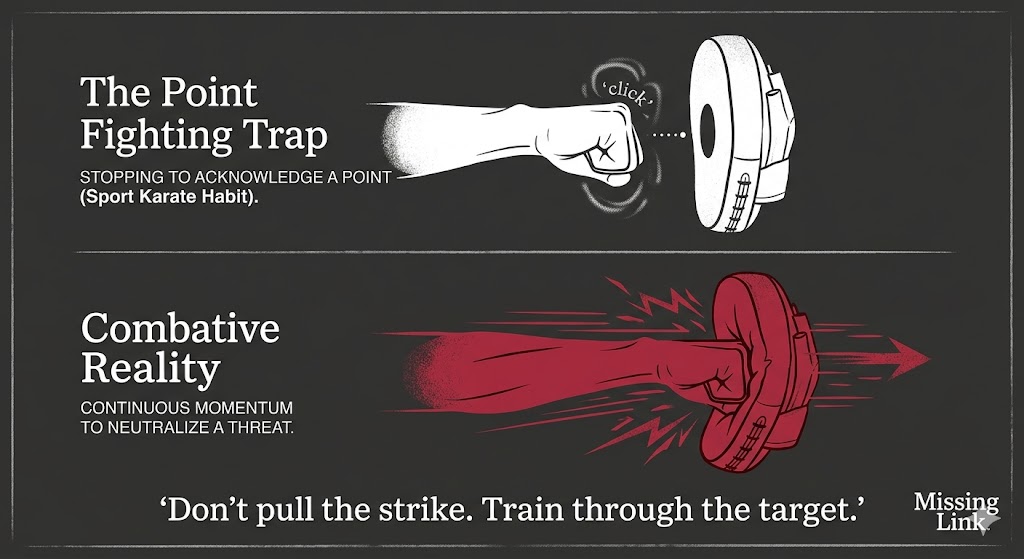
Sport karate is a fantastic game of tag. It builds speed, timing, and distance. However, it teaches a fatal habit for self-defence: the "pull." In the dojo, we stop our technique the moment it lands (or just before) to protect our partner. We pause to acknowledge the point.
In reality, an aggressor does not stop because you touched their face. If your muscle memory is wired to retract and relax after one strike, you are vulnerable. We must train through the target. We must keep the engine running until the threat is neutralized. Enjoy the sport, but never confuse a match with a fight.
2. The Grappling Void
There is a modern myth that "strikers lose to grapplers." This is only true if the striker refuses to acknowledge the existence of grappling.
Original Okinawan karate was not just punching; it was full of Tegumi (grappling) and Tuite (joint manipulation). Over the last century, as karate modernized, we polished the strikes but forgot the wrestling. Real altercations rarely stay at long range. They crash into clinches, shirt-grabbing, and shoving matches.
We don't need to become BJJ athletes or roll on the floor for twenty minutes seeking a submission—that is dangerous in a street environment where there might be glass, curbs, or a second attacker. Instead, we must reclaim the stand-up grappling hidden in our Kata. We need to be comfortable with contact, able to stabilize our base when grabbed, and capable of sweeping an opponent to the floor while we stay standing.
3. The Legal Line
A "functional" system isn't just about winning a physical altercation; it's about surviving the aftermath. In the UK, the Crown Prosecution Service (CPS) is clear: force must be "reasonable and proportionate."
There is a difference between neutralization and revenge. If a threat is fleeing, and you chase them down to "teach them a lesson" (as seen in the Munir Hussain case), you are no longer defending; you are assaulting. We must train our judgment as much as our reverse punch. Knowing when to stop is a martial skill.
4. The Art of Avoidance
The most effective technique in the Missing Link syllabus is not in Heian Godan. It is awareness.
If you are fighting, something has already gone wrong. Police and security experts agree that situational awareness—scanning the room, spotting aggression early, and leaving—is the superior tactic. We train to fight so that we have options when we are cornered, but we train our minds to ensure we rarely get cornered in the first place.
Sensei Tony Bolton is Chief Instructor for England. He teaches in Manchester: www.manchester-karate.uk
Combat often looks chaotic. Especially in unarmed fighting, many things happen at once: movement, striking, pressure, balance, clinch, interruption, disengagement, re-entry. Because of this density, fighting is often experienced as unpredictable. But experienced practitioners frequently notice something else. Beneath the apparent chaos, recognizable structures begin to appear. Not fixed techniques. Not scripted sequences. But recurring […]
Keep what survives contact. This article shows how constraints, cycles, and partner pressure turn values into behaviour — and training into something that lasts. Sandro Sandten teaches partner-contact–oriented Karate with a pedagogical and sustainable design focus. His work centres on training systems that remain functional under real-life variability — honest partner interaction, clear constraints, and […]