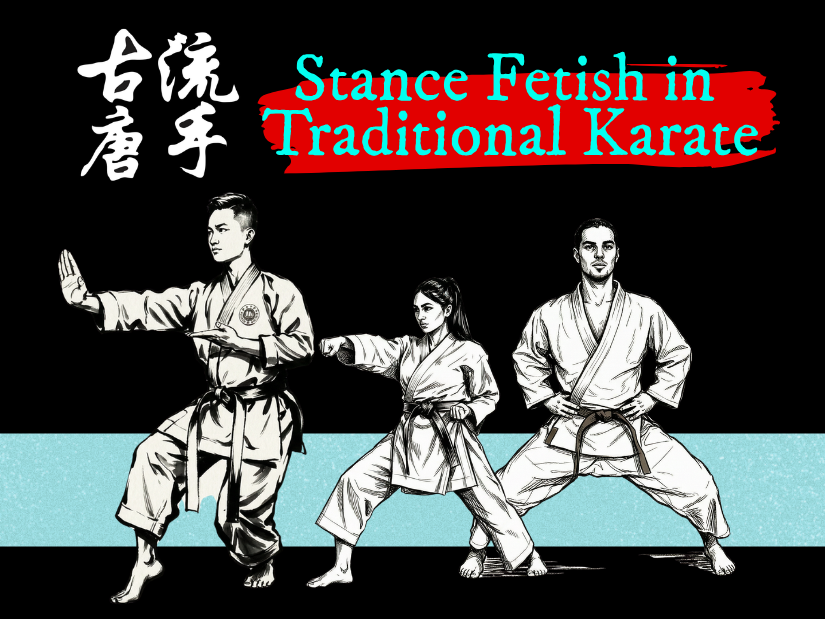
There is a curious obsession in traditional martial arts, and karate in particular, with the way you stand. Not with how you move, not with how you get somewhere, but with the precise frozen moment at the end of a technique — the stance. The angle of the foot. The bend of the knee. The exact degree to which a hip is turned. These are the things instructors have argued and disagreed about for decades, sometimes with a fervour that borders on the theological.
I remember those lessons clearly. Long stretches of time spent standing — standing — in a set position while the instructor moved from student to student, correcting an elbow here, nudging a foot a few centimetres there. Exhausting, and not in the productive way. The stance had become the curriculum.
It is worth asking how this happened.
Part of the answer is measurement. A stance is visible. It can be photographed, drawn in a book, described with numbers and angles. When the Asian martial arts arrived in Europe, much of what was transmitted came through printed material — static images of the final position of a technique. People absorbed those images and strived to recreate them. Nobody thought to ask: how do I get into that position? What happens next? The picture showed a destination but said nothing about the journey.
Measurement also feeds into grading and competition. Examiners need something concrete to evaluate. A stance provides exactly that — a yes or no, correct or incorrect, measurable unit of quality. It is easy to define style by it too. "In our school we stand like this; in yours, you stand like that." Stances become identity. They become politics.
And then there is the health problem, which is not a small one. The very low, wide stances demanded particularly in Kihon training have contributed to a generation of practitioners who, as they age, find themselves needing hip replacements or knee surgery. Joints simply were not designed for the sustained, exaggerated demands of certain traditional stances. The training method that was supposed to build strength was quietly causing damage.
Here is the thing that makes all of this strange: the stance itself is not the point.
A stance is a moment. It is a split second within a larger movement — either the end point of one technique or a transitional position on the way to the next. In actual practice, in Kumite, in realistic application, nobody stands. Everyone moves. The question that should drive training is not "am I standing correctly?" but "how do I move through this position effectively?" The stance is a brief snapshot in a film; most karate training has been treating it as if the film exists purely to justify the photograph.
This reframing changes everything. If the stance is a moment within movement, then the quality of a stance is determined by how you arrive at it and what you can do from it. A deep, angular, technically "correct" stance that locks your hips and prevents further movement is not good karate. It is a display. It is, to use an unkind but accurate word, topiary — the Japanese garden clipped into a particular shape for appearance rather than for life.
What matters is whole-body movement: how the muscles connect and work together, how weight shifts, how momentum is generated and controlled. The focus must be on moving, not standing. How you get into a position. How you get out of it. The transition is the skill.
The oldest kata already knew this. Look carefully at the genuinely old forms and you will find stances that are higher, more mobile, more versatile than what became standard in the twentieth century. The lower, more exaggerated postures came later, shaped by a desire for visual uniformity, for athletic spectacle, for something that looked impressive in a demonstration or a photograph.
Good training corrects this. Every stance in our curriculum comes with a clear note: the priority is not the end position, but the movement itself. The stance describes a principle of weight distribution, of alignment, of readiness — not a pedestal to stand on while someone checks your angles.
Move first. The stance will follow.
Heero Miketta is Member of The Founder Circle.
He teaches in Scotland: www.martialarts.scot