Beyond the Cute Photos: The Reality of Martial Arts for Children
Parents often bring their children to the dojo with a specific vision in mind. They hope for a bully-proof child, better school grades, iron discipline, and perhaps some lovely photos in a crisp white uniform for the grandparents. These are understandable desires. Yet, they often miss the actual purpose of our practice.Martial arts is not a factory for creating miniature adults. It is a bridge back to the self.
The Myth of the Miniature Master
We have all seen the viral videos online. A five-year-old monk performing flawless acrobatic martial arts, or a tiny gymnast executing impossible routines. They look like highly skilled adults trapped in tiny bodies.
It is easy to watch these clips and wonder why your own child cannot do the same. The reality behind those videos is a combination of rare talent and a level of rigid, painful discipline. That kind of training often comes at the direct expense of a normal childhood and basic social skills. You do not achieve those viral results through play. You achieve them through a process most parents would never willingly subject their children to.
In our dojos, we choose a different path. We do not sacrifice social development for early athletic perfection.
Counteracting Debodification
Modern life pushes us towards a dangerous disconnect between mind and body. We call this debodification. Children today spend hours interacting with flat screens, sitting still, and existing entirely in their heads.
Emotional learning is fundamentally tied to physical experience. To understand conflict, you must feel it. The experience of physical struggle in the safe environment of a dojo teaches profound lessons about managing non-physical fights in the real world. A good martial arts class forces the mind to reconnect with the body. It provides the physical feedback necessary for true social and emotional growth.
Age-Appropriate Expectations
The learning curve in martial arts is not a straight line. What a child needs from the dojo changes drastically depending on their developmental stage. Teachers must manage these expectations honestly, rather than promising the world just to fill a room with fifty kids running in chaotic circles.
The Early Years (Under 8)
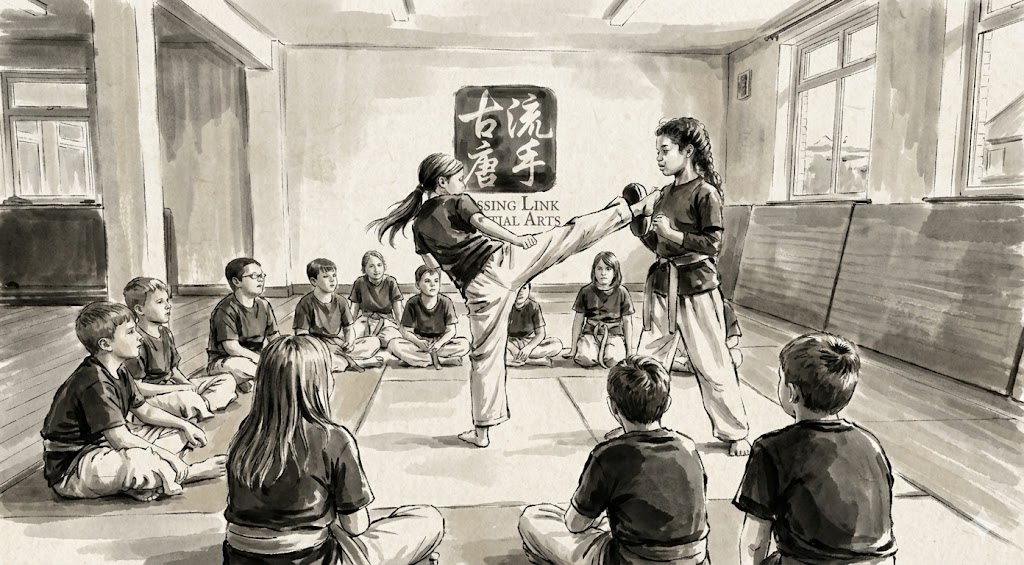
For very young children, the focus must be on discovering the body, developing basic motor skills, and learning social interaction and dealing with conflict. This requires a highly playful approach. In our Manchester classes, we run dedicated Bonsai classes for this exact purpose. It is about movement and cooperation, about fighting and conflict, not complex technique or principles. Trying to teach deep martial philosophy to a five-year-old is like trying to plant a structured Japanese garden in the middle of a playground.
The Turning Point (Ages 8-9+)
Around seven or eight years old, cognitive and physical abilities begin to align. This is when deeper, holistic learning becomes possible. We can introduce the structured basics (Kihon) and forms (Kata), and begin to explore how they connect to real movement and particularly principles.
Focused Peer Training
As students mature, the training format must evolve. In our Scottish locations, we currently do not offer classes for very small children. Instead, we utilise Shoshin groups, rooted in the concept of the "beginner's mind." These are intense, highly focused peer groups for older children and adults. They work together, teach each other, and often supplement their learning with private lessons to tackle specific topics. This level of focus is impossible—and inappropriate—for a five-year-old.
A Lifelong Practice, Not a Playgroup
Martial arts is frequently misunderstood as merely a children's activity—a phase you eventually outgrow. This could not be further from the truth. The holistic benefits of reconnecting body and mind are just as vital for adults.
Grown-ups often underestimate how much they can learn, even if they start late. Re-entering the dojo, or stepping onto the mat for the first time at forty, offers a profound way to counteract the debodification of adult life. It is a lifelong practice, a constant balancing of our traditional foundations with the chaotic jungle of modern application.
We have a responsibility to be honest with our students and their parents. We must provide training that meets the actual needs of the individual standing in front of us, regardless of their age.
A few years ago we recorded a GLIMPSE video that got a bit of attention. We were asked to create a readable version for those of you who do not want to sit through a lengthy chat. Fear originates in the amygdala, triggering a chemical cascade including adrenaline. Everyone reacts physically the same way — […]
Some deeply personal thoughts by Sensei Chris Edwards The people that know me well know how much I struggle with my Mental Health. My one saving grace between my job as a Nurse and my other stresses in life is Martial Arts. Without Martial Arts, or Karate in particular, I know for a fact I […]