Does martial arts train character? Many of us started martial arts because we were looking for more than just movement or self-defence. We wanted to develop a posture—an attitude—to understand ourselves better and to find a path that connects physical training with personal development.
There is a lot of talk about values such as respect, discipline, mindfulness, or integrity. Some are written on the Dôjô wall; others are recited before class. Yet the real question remains:
How do these values shape our practice—and how consciously do we exercise them?
The reality is that groups, instructors, and all practitioners interpret values differently. This is not a bad thing; it is reality. What is important is to make these differences visible and reflective.
This article aims to offer impulses on how we can see our personal values and the values of our training environment more clearly, discuss them more consciously, and live them more constructively.
1. Tradition meets Reality – and that is a good thing
Traditional martial arts possess historically evolved concepts of value. But we live in a time where we do not simply adopt this tradition; we seek to understand and develop it further.
Values such as respect, willingness to learn, responsibility, safety, and mindfulness are timeless—but their implementation changes:
Respectful interaction today does not necessarily mean rigid hierarchy.
Discipline does not mean blind obedience, but reliability and engagement.
Self-control does not mean suppressing emotions, but acting appropriately.
Mindfulness today includes emotional, mental, and physical safety.
Tradition is not a museum piece—it is a toolbox that we use sensibly and responsibly.
2. Personal Value Reflection – Clarity for your own practice
Before talking about Dojo values, it is worth starting with yourself. This creates orientation on your own path of practice.
Choose what truly influences your real training everyday life—not what simply sounds "ideal".
Step 2: How does this value manifest in you?
Example "Consideration":
I adjust my intensity to suit my partner.
I accept the tempo and boundaries of others.
Step 3: What do you actively do to strengthen this value?
Example "Discipline":
I structure my week so that training realistically has a place.
If necessary, I leave earlier to be punctual before the class starts.
I pack my bag the day before, rather than at the last minute.
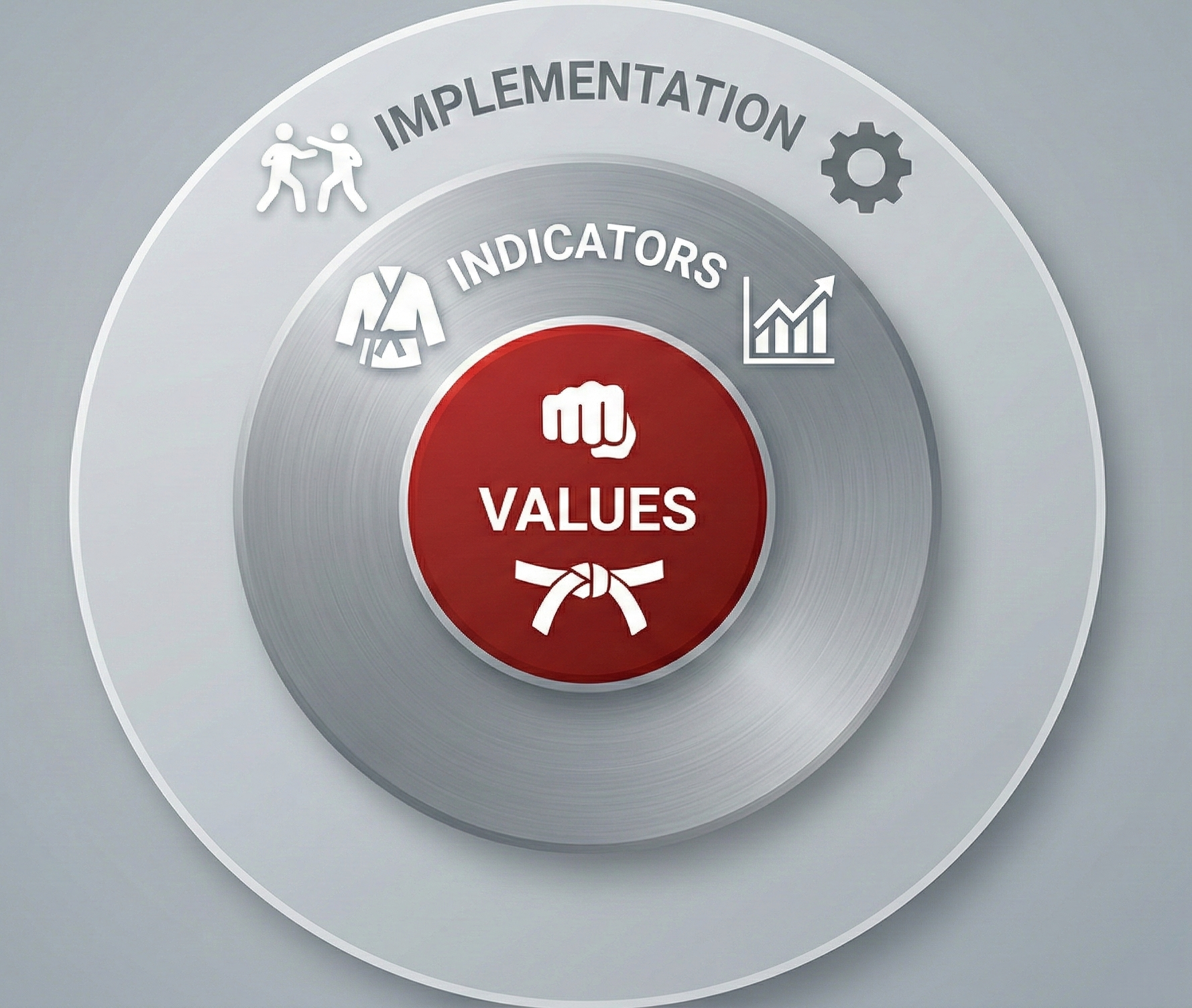
Values Golden Circle (Practice Format)
Inside: Your core values
Middle: How one recognises them
Outside: What you actively do for them Many practitioners integrate this schema into a training journal—a modern form of the "Dô" concept: walking the path, consciously reflecting.
3. Values in the Dojo – clear, explainable, and grounded
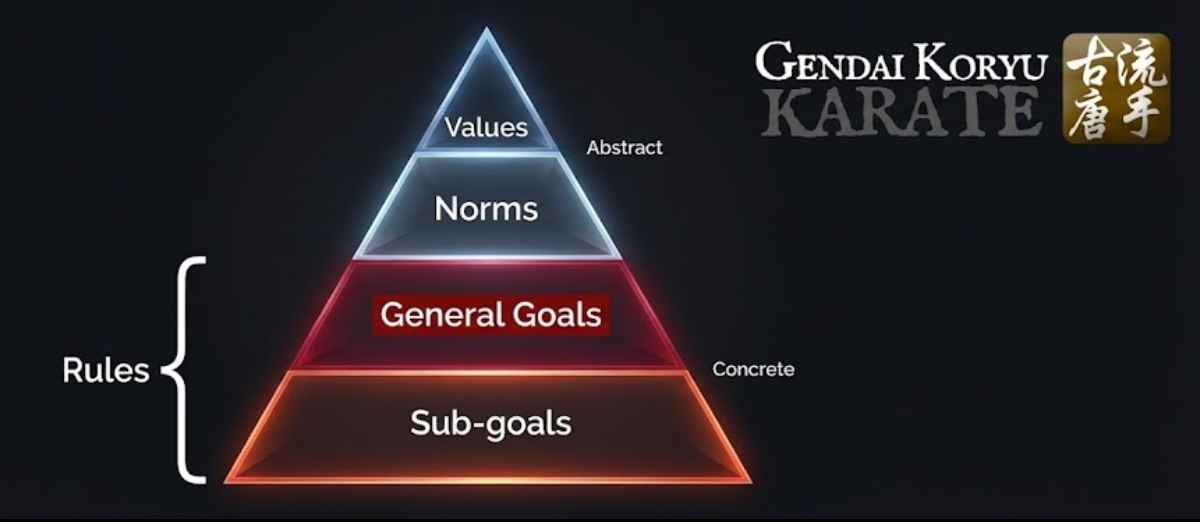
In modern schools, rules are often set by the instructor or the leadership team—and this makes sense. Safety, structure, and a common framework are indispensable. However, transparency is crucial: Rules work best when it is clear which value stands behind them.
Here are some practical comparisons:
VALUE: Safety & Responsibility
RULE: Contact, intensity, and risk are discussed openly.
MEANING: No one has to "act brave" to belong. Safety is based on communication, not on hardness.
VALUE: Learning Orientation instead of Ego
RULE: Exercises are not sabotaged in order to "win".
MEANING: Technique before triumph; development before demonstration.
Traditional terms may still provide the headlines—but their implementation is contemporary, responsible, and realistic.
4. How Values can be concretely trained
Values are not theory; they must be experienced and practised. Here are some practical ideas:
Conscious change of partners
Briefly perceive: Who is standing in front of me?
Discuss intensity.
Clearly formulate what you need yourself.
➡ Trains responsibility and communication.
Check-in and Check-out
One minute before starting: "How am I entering training today?"
One minute at the end: "What am I taking with me? What am I leaving behind?"
➡ Trains presence, reflection, and respect for one's own process.
Short entries like: "This week I am paying particular attention to..."
➡ A modern form of character work.
5. Conclusion: Values are not a relic – they are development potential
Traditional martial arts do not live by keeping old rituals unchanged, but by understanding their essence and transferring it into our time.
Values such as respect, mindfulness, responsibility, or integrity must be liveable, explainable, and trainable today. When personal values and Dojo rules come together, a learning space is created that is:
safe
authentic
motivating
reflective
human
And that is exactly what makes modern martial arts a living tradition.
A few years ago we recorded a GLIMPSE video that got a bit of attention. We were asked to create a readable version for those of you who do not want to sit through a lengthy chat. Fear originates in the amygdala, triggering a chemical cascade including adrenaline. Everyone reacts physically the same way — […]
Some deeply personal thoughts by Sensei Chris Edwards The people that know me well know how much I struggle with my Mental Health. My one saving grace between my job as a Nurse and my other stresses in life is Martial Arts. Without Martial Arts, or Karate in particular, I know for a fact I […]