Combat often looks chaotic. Especially in unarmed fighting, many things happen at once: movement, striking, pressure, balance, clinch, interruption, disengagement, re-entry. Because of this density, fighting is often experienced as unpredictable. But experienced practitioners frequently notice something else.
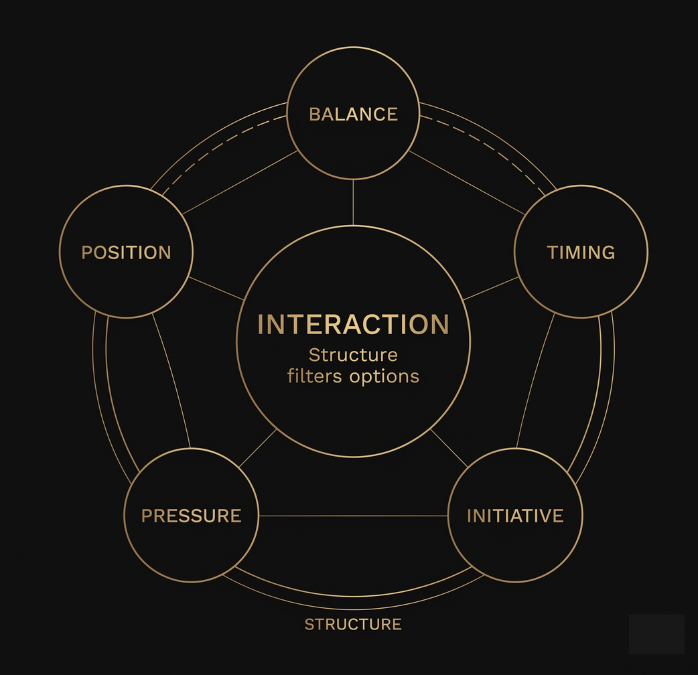
Beneath the apparent chaos, recognizable structures begin to appear. Not fixed techniques. Not scripted sequences. But recurring relationships between position, balance, pressure, timing, and available options.
This article is not about techniques. It is about how decisions become possible under pressure.
Chaos Is Only the Surface
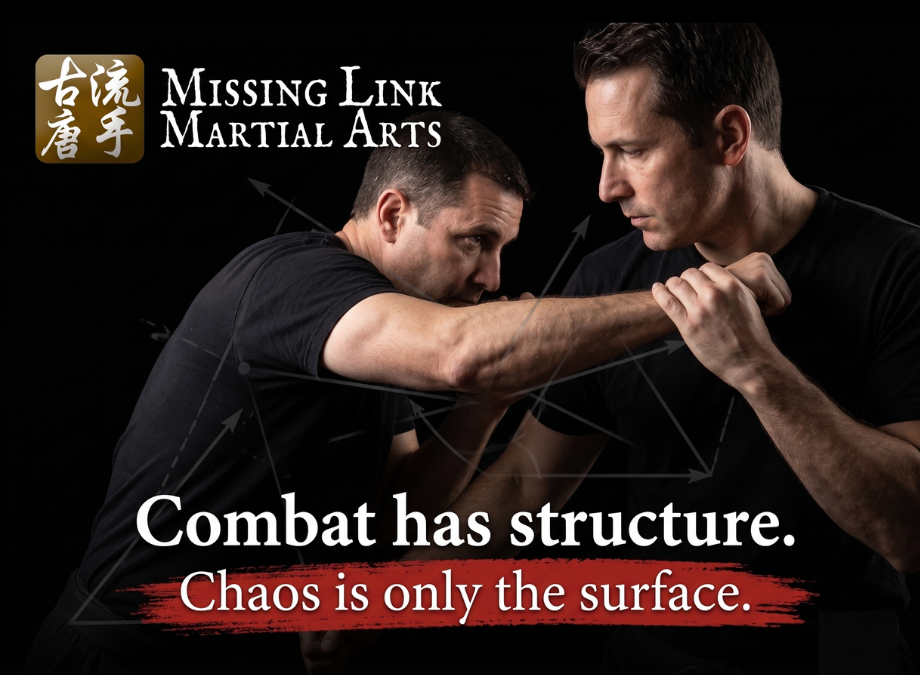
Combat is not random — but it is dynamic. What looks chaotic from the outside is usually a rapidly changing interaction between two people who continuously influence each other. As experience grows, patterns start to emerge. Not because situations repeat exactly, but because structural relationships repeat:
how position affects available lines
how balance affects attention and initiative
how pressure changes mobility and options
These structures do not dictate actions. They filter them.
Structure Changes Options
Many effective actions in combat work not because of speed or strength alone, but because they change structural relationships between two people. Examples:
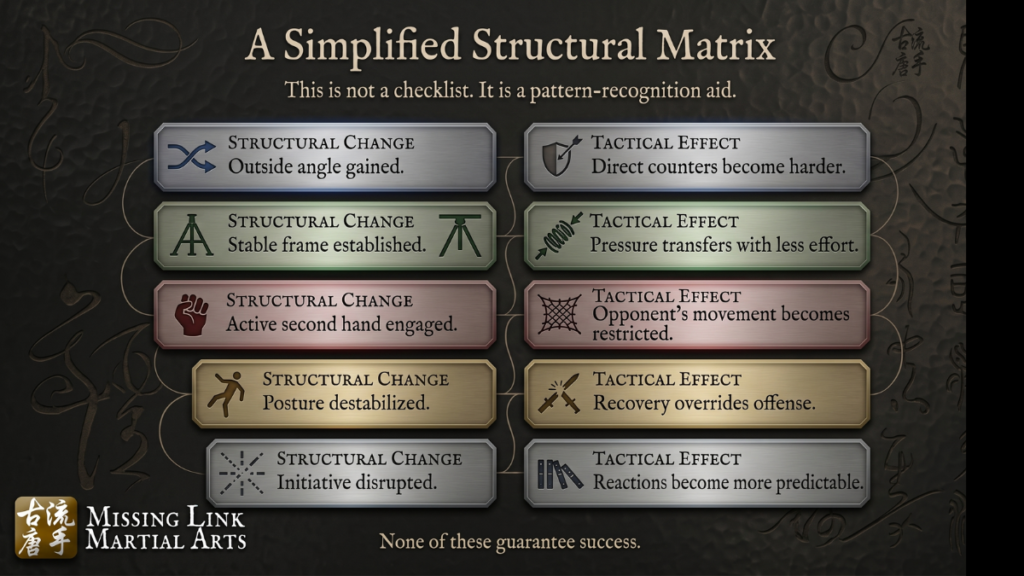
Occupying an outside angle reduces direct counterlines.
A stable frame redirects pressure without excessive muscular effort.
An active second hand limits movement, protects vulnerable space, and maintains connection.
Destabilizing posture shifts attention away from offense toward recovery.
In many cases, successful techniques emerge naturally once these relationships have already changed. The technique itself is often only the visible endpoint of a larger structural process.
Pressure Is Often Structural
Pressure is frequently misunderstood as aggression or forceful pushing. In practice, effective pressure often comes from alignment rather than effort. A properly aligned structure transfers bodyweight efficiently into the opponent’s structure without excessive tension. An upper arm used as a stable frame can function like a support beam or doorstop: reliable not because it is rigidly muscular, but because skeletal alignment transfers force consistently.
This is why experienced practitioners sometimes feel unexpectedly “heavy” — not because they use more strength, but because their structure wastes less energy while restricting movement more effectively.
Combat Is Built on Tactical Relationships
Very few actions in combat exist independently. Most movements are responses to expected responses.
Forward pressure influences retreat.
Defensive focus changes available openings.
Control reduces mobility.
Position shifts initiative.
This does not make combat predictable. But it does make it readable. Skilled practitioners are rarely reacting randomly. They recognize recurring tactical relationships earlier — and adjust sooner.
Perception Often Comes Before Action
One of the key differences between experienced and inexperienced practitioners is not technical knowledge alone. It is perception. Experienced practitioners often recognize structural weakness before a technique is fully applied:
compromised posture
narrowing escape paths
moments where balance recovery overrides offense
positions where pressure can no longer be redirected efficiently
Many meaningful decisions happen before visible action unfolds. That is why timing in martial arts is rarely just speed. Often, it is perception becoming action at the right moment. Traditional concepts such as:
Go no Sen
Sen no Sen
Deai
can be understood as observations about initiative, timing, and shifting tactical opportunity. Not mystical ideas — but descriptions of interaction. They describe when something becomes possible, not what to do.
None of these guarantee success. They describe recurring tendencies that appear repeatedly under pressure and interaction.
What Training Should Develop
Good training should not only improve isolated techniques. It should improve the ability to perceive:
changing structure
balance shifts
pressure direction
narrowing options
emerging tactical opportunity
Because combat does not happen through techniques alone. It happens through interaction between changing structures. Training that focuses only on techniques delays decision-making. Training that repeatedly exposes practitioners to changing structure accelerates perception.
Closing Principle
Combat may always appear chaotic from the outside. But beneath that chaos, structure still exists.
And the better practitioners become at recognizing structural relationships, the earlier they can make meaningful decisions — sometimes before techniques fully unfold, and sometimes before the opponent realizes a decision is already being made.
Sandro Sandten is the Chief Instructor for Missing Link in Germany, teaching partner‑oriented Karate from Meerbusch (near Düsseldorf) with a focus on constraints‑led, sustainable training.
Combat often looks chaotic. Especially in unarmed fighting, many things happen at once: movement, striking, pressure, balance, clinch, interruption, disengagement, re-entry. Because of this density, fighting is often experienced as unpredictable. But experienced practitioners frequently notice something else. Beneath the apparent chaos, recognizable structures begin to appear. Not fixed techniques. Not scripted sequences. But recurring […]
Keep what survives contact. This article shows how constraints, cycles, and partner pressure turn values into behaviour — and training into something that lasts. Sandro Sandten teaches partner-contact–oriented Karate with a pedagogical and sustainable design focus. His work centres on training systems that remain functional under real-life variability — honest partner interaction, clear constraints, and […]