Keeping Martial Arts Alive Without Chasing Every Trend
Keep what survives contact. This article shows how constraints, cycles, and partner pressure turn values into behaviour — and training into something that lasts.
Sandro Sandten teaches partner-contact–oriented Karate with a pedagogical and sustainable design focus. His work centres on training systems that remain functional under real-life variability — honest partner interaction, clear constraints, and progression that survives pressure.
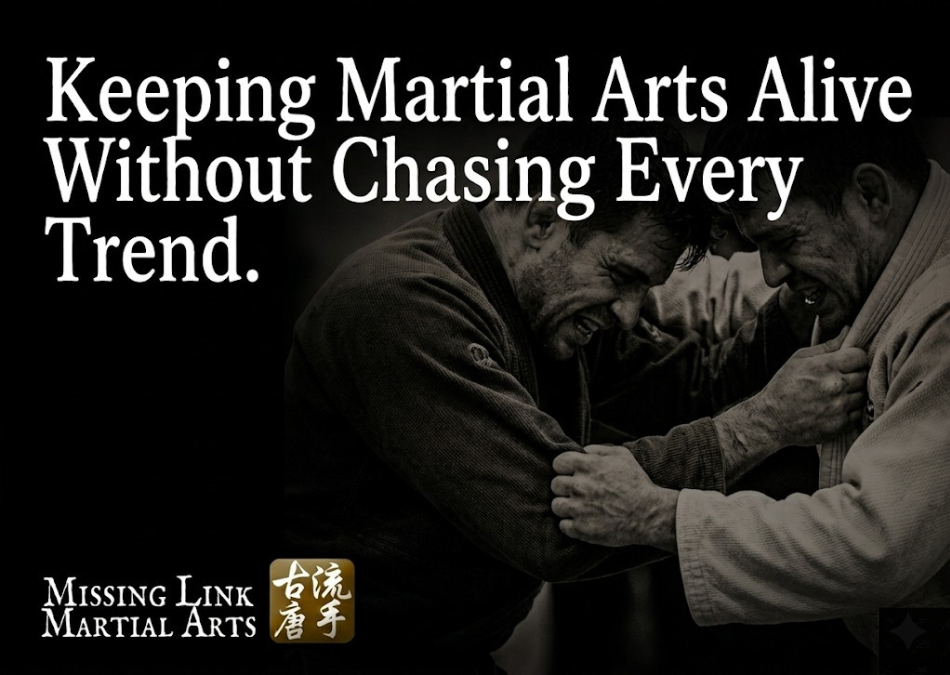
Martial arts are constantly evolving. New drills, training ideas, movement concepts, and teaching methods appear all the time. Some disappear quickly. Others stay — not because they are new, but because they survive contact with real partner training.
That is usually where the difference becomes visible: between what looks interesting and what actually holds up when timing, pressure, balance, and resistance enter the room.
This is not about trends.
Training does not become better just because it is modern. And it does not become better just because it is traditional. Most of the time, both arguments miss the point. The real question is not what system something comes from. It is this: What survives when a real partner doesn’t cooperate anymore?
Core principle: The value of any training idea is not defined by its origin, but by what remains when timing, pressure, and imbalance are added.
The problem with martial arts discussions
A lot of conversations in martial arts repeat the same pattern. One side protects structure, repetition, and technical clarity. The other side pushes pressure, chaos, and “realism”. Both are right. Both are incomplete.
A training environment without structure becomes noise. A training environment without pressure becomes abstraction. Somewhere between those two extremes is where skill development actually happens — not in theory, but in repeated partner interaction over time.
What actually develops skill
Skill does not develop in explanation. It develops when the same situation is repeated often enough that the body starts choosing differently. Not because someone told it to. But because the old solution stops working under changing conditions.
That is the part many miss: you do not remove bad habits by correcting them once. You replace them by making them fail — repeatedly, under controlled conditions — until something better appears.
Training philosophy: Good training does not replace habits through instruction, but through structured repetition under changing constraints until better responses become more available than old ones.
What should stay constant
Some elements of training do not change much — even when everything else evolves. Partner interaction is one of them. Not as an idea, but as a requirement: distance, timing, balance, pressure, reaction — all of it only exists between two people. Alongside that:
coordination
mobility
technical basics
repetition
These are not “foundations” in a motivational sense. They are what allows anything else to function under stress.
Especially in real-world training environments — where people arrive tired, distracted, or inconsistent — the system must remain usable over time. Not maximal. Not heroic. Sustainable. Because consistency is not repetition of content. It is the ability to keep training without breaking the system.
Consistency principle: Consistency is not repetition. It is the ability of a training system to remain functional under real-life variability over time.
Constraints are not theory — they are design
One of the most useful shifts in training is this: Stop thinking of constraints as a concept. Start thinking of them as a design tool for behaviour. Every partner interaction already contains constraints: balance, structure, distance, timing, reaction. The question is only whether you leave them random or whether you shape them on purpose.
In structured partner work, constraints do something very specific: they don’t teach a solution. They remove options. When options are reduced, people stop repeating their first reaction. That is where learning becomes visible. In groups, you can watch it over time. At first, students fall back into familiar reactions under pressure:
the same timing
the same tension response
the same mistakes
But when the same constraint returns often enough, something shifts. Not immediately. Not cleanly. Sometimes almost invisibly. Old reactions stop being automatic. New ones start appearing without being forced. And eventually, what looked “unnatural” becomes simply more usable.
Not because it was explained better — but because it survived repetition under pressure.
Cycles make training readable over time
Training without structure becomes random. Training with too much structure becomes rigid. A cycle of 10–15 weeks sits somewhere in between. Not as a rigid program, but as a temporary focus. Within that cycle, short recurring segments (10–15 minutes) are enough to build continuity:
balance disruption and recovery
close-range engagement and control
structural alignment under contact
transition between control and release
re-establishing connection after loss of structure
What matters is not variety. It is return: coming back to the same theme often enough that it starts changing how people move — sometimes before they notice it themselves.
A practical reality: interaction is never clean
Any integrated training sequence — especially when it includes imbalance, falling, control, and re-engagement — will look messy at first. That is not a problem. That is information. People do not become better under pressure just because a drill is structured. First, they become honest.
Old habits appear faster under constraint, not slower. Only after enough repetitions do they start to reorganize. Not in a straight line. Not evenly across a group. But noticeably over time. Some adapt quickly. Some resist longer. Some switch between old and new patterns for a while. That is normal.
Training is not linear improvement. It is pattern replacement under repetition.
Interaction is the real progression system
Footwork, timing, distance, and initiative are often treated as separate skills. In practice, they are expressions of one thing: How a person behaves when another person doesn’t agree with them. That is why progression cannot be purely technical. It moves through phases of interaction:
stable cooperation
changing timing and initiative
increasing resistance
pressure under fatigue and unpredictability
Not as a ladder. More as a shifting environment. Because real training does not stay in one phase for long.
A 90-minute session is just a container
A session structure is not the training. It is a frame that keeps interaction organized long enough for something meaningful to develop. A simple example:
10 min — preparation and coordination
15 min — technical work with feedback
10–15 min — recurring cycle focus
20 min — structured partner interaction under constraints
15 min — applied work with higher intensity
5–10 min — optional fatigue or movement work
5 min — closure and reflection
What matters is not the order. It is whether the interaction inside it is alive.
Final Thoughts
Martial arts do not stay alive because they are modern. And they do not survive because they are traditional. They stay alive when training remains connected to what actually happens between people: between structure and resistance, between control and disruption, between intention and reaction.
Most of the time, progress does not come from adding something new. It comes from removing unnecessary choices — and letting better ones survive long enough to become natural.
Closing principle: Skill is not created by repetition alone, but by repetition under conditions that force old patterns to fail until better ones become inevitable.
Sensei Sandro Sandten is Chief Instructor for Germany. He teaches in Meerbusch: www.karate-meerbusch.de
Combat often looks chaotic. Especially in unarmed fighting, many things happen at once: movement, striking, pressure, balance, clinch, interruption, disengagement, re-entry. Because of this density, fighting is often experienced as unpredictable. But experienced practitioners frequently notice something else. Beneath the apparent chaos, recognizable structures begin to appear. Not fixed techniques. Not scripted sequences. But recurring […]
Keep what survives contact. This article shows how constraints, cycles, and partner pressure turn values into behaviour — and training into something that lasts. Sandro Sandten teaches partner-contact–oriented Karate with a pedagogical and sustainable design focus. His work centres on training systems that remain functional under real-life variability — honest partner interaction, clear constraints, and […]